Honolulu & Kahului, Hawaii · 2022
Honolulu & Kahului Airports
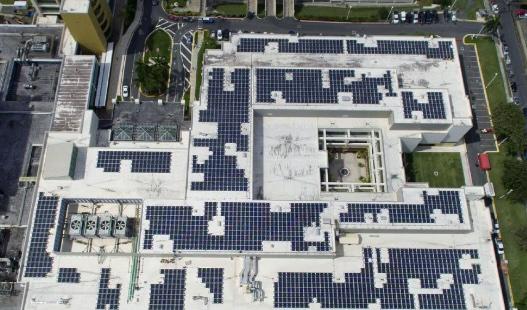
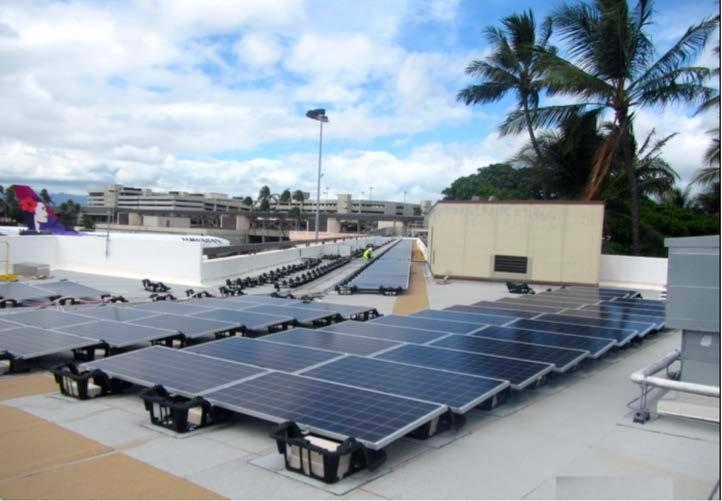
The Hawaii Department of Transportation selected FastRack 510-6dg to mount 8,148 72-cell modules across more than ten tiered rooftops at Honolulu and Kahului airports, meeting aggressive clean-energy, seismic, and hurricane-resilience goals.
System size
2,474 kW-DC
Completed
2022
- Location
- Honolulu & Kahului, Hawaii
- Modules
- 8,148 × Trina Solar & JA Solar 72-cell
- Mounting system
- FastRack 510-6dg at 5° tilt
- Mount type
- Rooftop
Why this project worked
- Largest rooftop deployment across Hawaii's two busiest airports
- Supports the Hawaii Clean Energy Initiative target of 70% clean energy by 2030
- Engineered for hurricane-force winds and high seismic activity
- Minimal seismic anchors installed at up to five per man-hour
Overview
The State of Hawaii Department of Transportation, Airports Division selected the FastRack 510-6dg to support roof-mounted photovoltaic systems at its two largest facilities, Honolulu International Airport and Kahului Airport. The Hawaii Clean Energy Initiative, in partnership with the State of Hawaii and the U.S. Department of Energy, has set a goal of 70% clean energy by 2030 — the most aggressive renewable target in the country.
FastRack 510-6dg was selected to mount 8,148 Trina and JA Solar 72-cell modules. The one-piece FR510 requires no assembly, and its universal design allowed the team to install four different module models using the same simple installation procedure. The non-corrosive Ultramid material and Sollega's engineering made the solution especially well-suited to the tropical, coastal region, while the high array density of the FR510-6dg allowed the DOT to meet its energy production goals.
These builds required a high degree of engineering: the airports sit in both hurricane-prone and high-seismic zones. Minimal seismic anchors were installed at up to five per man-hour. The arrays spread across more than ten individual flat roofs, many of them tiered, which made moving equipment to upper levels logistically difficult. Sollega's engineering team kept ballast to a minimum to ease that challenge, and Sollega's flexible wire-management system and high roof clearance made stringing the modules fast and efficient.
%20v.jpg&w=2560&q=75)